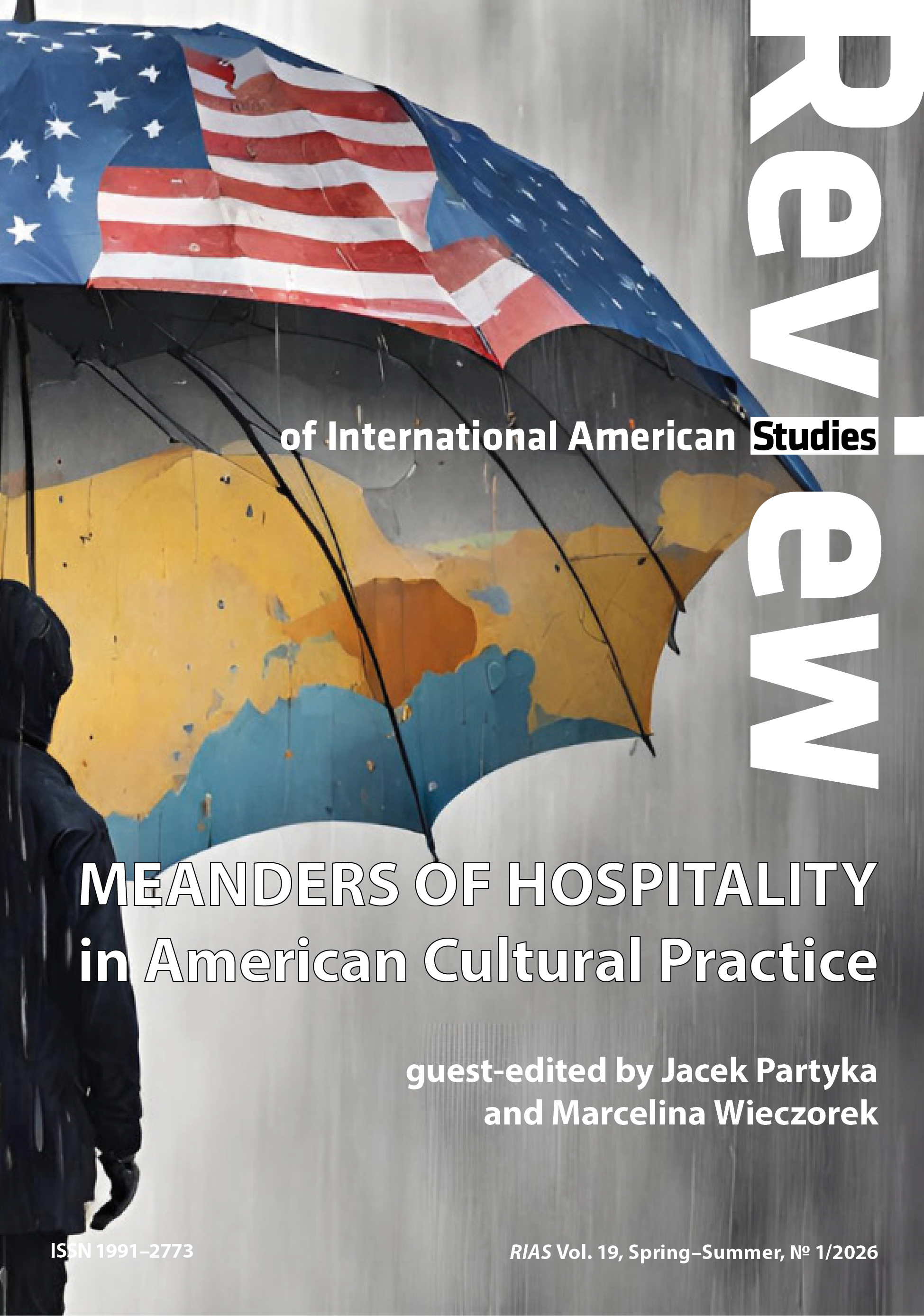
This introduction to the RIAS thematic issue argues that hospitality is, by its very nature, a utopian concept: an ideal recognized as both necessary and real, yet one that, in its fullest form, remains forever out of reach. Rather than treating this as a failure, the essay suggests that the irreducible tension between conditional and unconditional hospitality is precisely what sustains it as an ethical imperative. Drawing on a range of theoretical frameworks—from Immanuel Kant’s cosmopolitanism and Emmanuel Levinas’s ethics of the Other, through Jacques Derrida and Anne Dufourmantelle’s aporia of hospitality and ontology of risk, to Leszek Kołakowski’s dialectic of the regulative idea and Zygmunt Bauman’s diagnosis of mixophobia—it maps the diverse dimensions of hospitality. These frameworks—linguistic, narrative, carnal, and ecological—are further illuminated through brief readings of American literary texts by Henry Roth, Herman Melville, and W. H. Auden, alongside references to erasure poetry by M. NourbeSe Philip, Tracy K. Smith, and Layli Long Soldier. The essay ultimately argues that literature enacts hospitality rather than merely defining it, performing at the level of form what philosophy can only propose at the level of argument. The individual contributions gathered in the “Features” section of the issue extend this inquiry across a range of genres and traditions, including Latina fiction, dystopian speculative literature, war memoirs, the graphic novel, neo-gothic writing, and the African American sonnet tradition.

 10.31261/RIAS


 English